Characterization of muskellunge breeding habitats and fishery at Lac Traverse (Sainte-Thècle, Quebec)
Authors :
1. Vanessa Duclos, Biologist, Bureau d’écologie appliquée
2. Karine Gagnon, Applied Ecology Technician, Bureau d’écologie appliquée
3. Stéphanie Langevin, Biologist, Bureau d’écologie appliquée
4. Clothilde Saint-Marc, M.Sc. Biogeosciences
5. Marc Pépino, Biologist, ministère de l’Environnement, de la Lutte contre les changements climatiques, de la Faune et des Parcs
In 2024, a project to characterize the spawning habitats of muskellunge (Esox masquinongy) and the associated fishery was conducted on Lake Traverse in the municipality of Sainte-Thècle, in the Mauricie region of Quebec. Carried out by the Bureau d’écologie appliquée (Bureau of Applied Ecology), this project relied on close collaboration between Muskies Canada, the City of Sainte-Thècle, the Mauricie and Central Quebec Regional Wildlife Management Branch of the Quebec Ministry of the Environment, the Fight Against Climate Change, Wildlife and Parks (MELCCFP), and numerous volunteer anglers from the region.
The project’s main objective was to document the critical habitats and muskellunge population of Lake Traverse in order to support the protection of aquatic environments and promote responsible sport fishing. In this context, the City of Sainte-Thècle facilitated the territorial anchoring of the project, the MELCCFP contributed to the fishing survey and biological analyses, while Muskies Canada played a central role in mobilizing fishermen and sharing expertise regarding muskellunge fishing.
Characterization of habitats likely to be used for reproduction
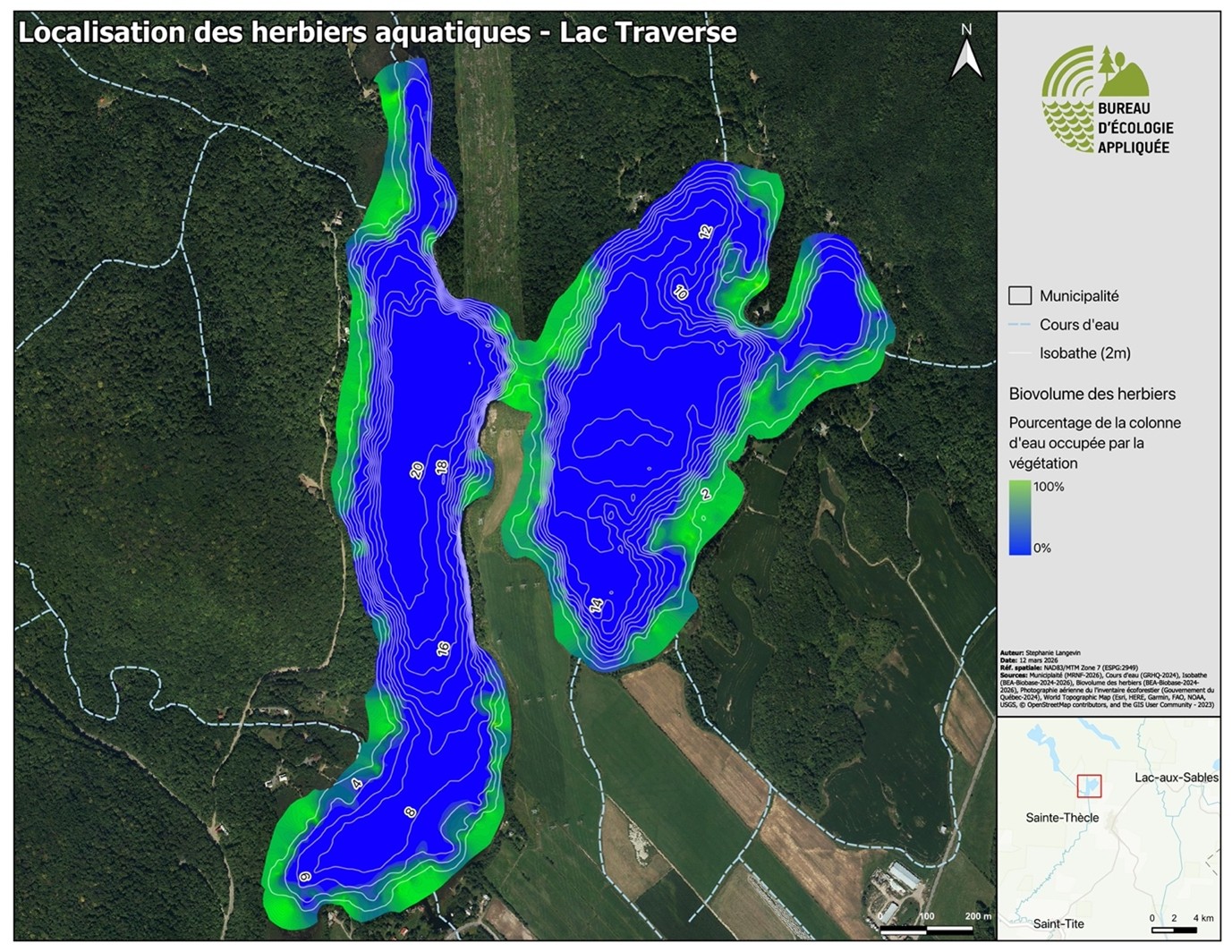
In the summer of 2024, a comprehensive bathymetric survey determined that Traverse Lake reaches a maximum depth of 22 meters, with an average depth of approximately 9.9 meters. The bays and shallow areas, combined with the presence of high-quality aquatic vegetation, offer particularly favorable conditions for the various stages of the muskellunge life cycle (Map 1).
The use of Lowrance sonar and BioBase software enabled the mapping of the distribution and biovolume of submerged aquatic vegetation, including areas of the lake that are difficult to observe visually from the shore or surface (Map 1). This approach identified shallow areas and submerged aquatic vegetation beds of potential interest to muskellunge, particularly due to their vegetation structure and location along the lake’s shoreline.
Although muskellunge reproduction has not been confirmed in these areas, the information obtained provides a valuable knowledge base for identifying habitats that may play a role in different stages of the species’ life cycle and for guiding future monitoring and conservation efforts. During the surveys, wetlands and wetland complexes likely to be used by muskellunge along the lake shore and at the mouths of certain tributaries were also briefly characterized (e.g., marshes and swamps). Areas directly connected to the lake show the greatest potential for use, highlighting the importance of maintaining ecological connectivity and free fish passage.

Constraints and disturbances
During the surveys, particular attention was paid to identifying natural constraints or human-induced disturbances that could impede the free movement of fish through the mosaic of habitats of interest. Specifically, biologists noted the condition of culverts that could potentially limit muskellunge access to potential habitats in waterways connected to the lake. Of the four culverts inspected around Traverse Lake, three were in good condition and functional, while one was destroyed. It was also observed that topography and the presence of impassable waterfalls limit access to certain areas upstream of tributary streams, reinforcing the importance of habitats directly connected to the lake.
Issues related to water level management and sediment inputs were also raised by residents, highlighting the crucial role of the municipality and land management practices in conserving muskellunge habitats.
Integrated portrait of the fishery and muskellunge population of Traverse Lake
As part of this project, two complementary data sources were used to better understand the muskellunge population of Lake Traverse: a fishing survey conducted with volunteer sport fishers and a growth analysis carried out by the MELCCFP team. Although based on distinct approaches, these two components together provide an initial overview of the fishery and the biological dynamics of the population.
The fishing survey, conducted throughout the 2024 fishing season (June to November), relied on the participation of volunteer fishers trained by the MELCCFP as well as local sport fishers. It documented fishing effort, the number of fish caught, the size of fish caught, and catch-and-release practices.
The data collected indicate that several dozen hours of fishing were investigated on Traverse Lake, leading to the capture of several dozen muskellunge during the 2024 season. The recorded sizes were mostly between approximately 75 and 85 cm, with a very high catch rate (93%), demonstrating responsible practices on the part of the anglers. While these results remain indicative and dependent on voluntary participation, they suggest an active and functional fishery on Traverse Lake with an average daily catch of 2.5 muskellunge per fishing group.
In addition, the MELCCFP conducted a growth analysis of muskellunge captured and tagged on Traverse Lake in June 2024. This analysis, based on 44 individuals for which age and length were available, relies on a von Bertalanffy growth curve[1].
The results show that the analyzed muskellunge had an average age of 6.9 years and an average length of approximately 28 inches. The Lake Traverse muskellunge population exhibits rapid growth, particularly during the early years of life. However, the assumed asymptotic length remains lower than that recorded in some large North American populations.
Taken together, the results of the fishing survey and the growth analysis provide an integrated picture of the muskellunge population in Lake Traverse. The sizes frequently observed by anglers correspond to young to middle-aged individuals, which is consistent with a population characterized by rapid growth but a more limited maximum size.
This dynamic suggests good access to food resources, while also hinting at potential constraints related to habitat, prey availability, or competition. The aquatic vegetation and high-quality wetlands identified during the project therefore play a key role in supporting this population and maintaining a viable fishery.
[1] The growth analysis was based on the von Bertallanffy growth curve:
Lt = L∞ (1 – exp(-k (t – t0))
where Lt is the length at age t, L∞ is the asymptotic length (maximum length for infinite growth), k is the growth coefficient that determines how quickly the asymptotic length is reached, t is the age, and t0 is the hypothetical age at which the length would be zero (adjustment coefficient to account for a non-zero length at birth). A nonlinear model was used for the growth analysis with the R software (R Core Team 2024). The coefficients were estimated using the nls basis function and the prediction interval of the growth curve, with the nlstools library (Baty et al. 2015).
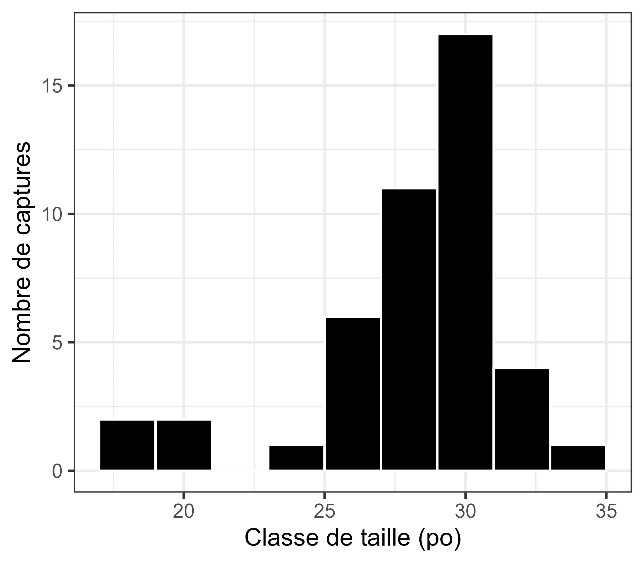
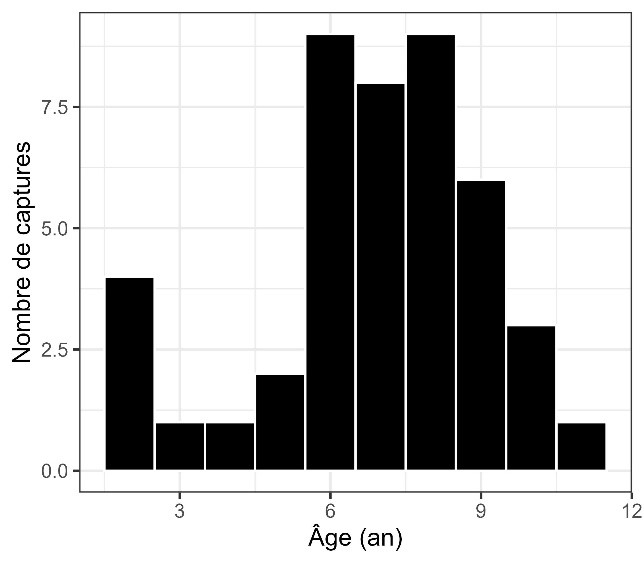
Figure 1. Length (left panel) and age (right panel) histograms in the Lake Traverse muskellunge population.
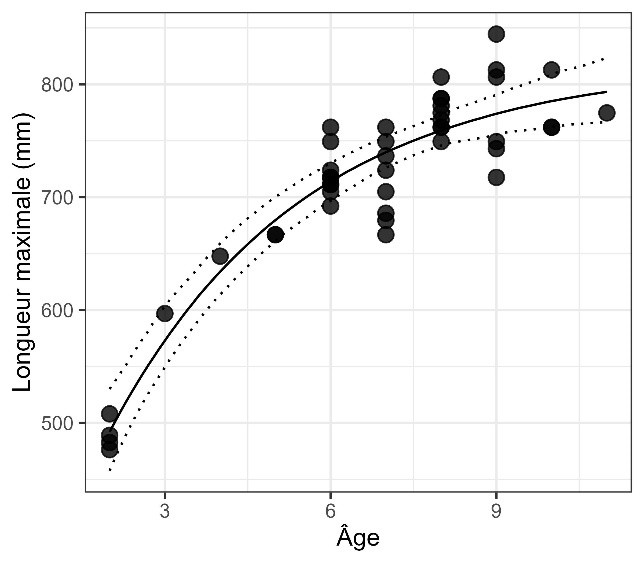
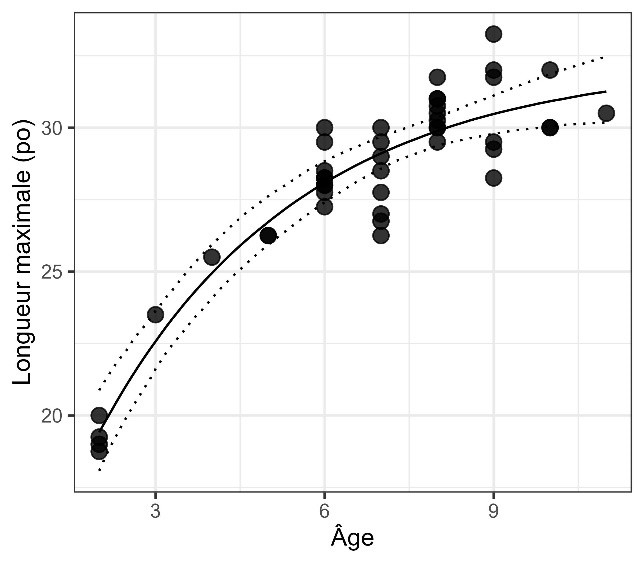
Figure 2. Length-age relationship in the Traverse Lake muskellunge population. The solid line represents the von Bertalanffy growth curve and the dashed lines the 95% uncertainty. Maximum total length is expressed in millimeters (left panel) or inches (right panel).
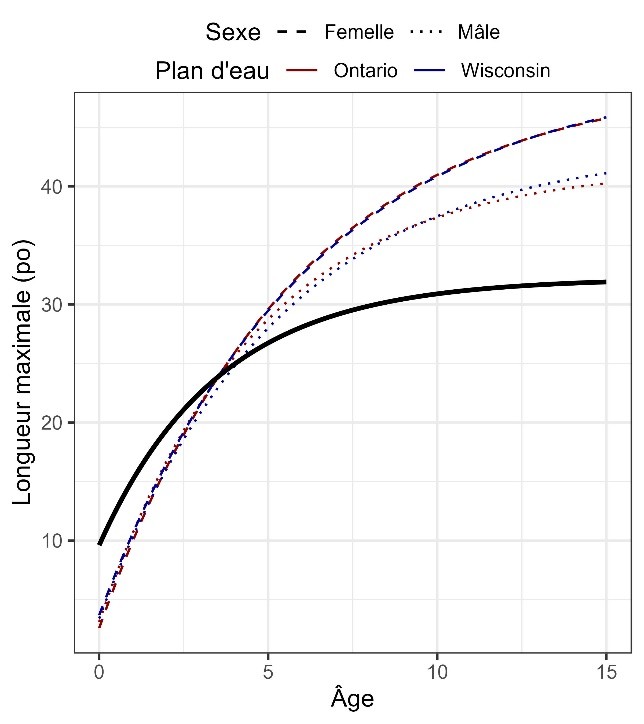
Table 1. Estimate and 95% and 99% confidence interval of the von Bertalanffy growth curve coefficients for the Lake Traverse muskellunge population.
|
Coefficients |
Estimated |
IC99,inf |
IC95,inf |
IC95,sup |
IC99,sup |
|
L∞ (po) |
32,23 |
30,26 |
30,65 |
35,19 |
36,92 |
|
L∞ (mm) |
819 |
769 |
778 |
894 |
938 |
|
k |
0,2833 |
0,1466 |
0,1786 |
0,4144 |
0,4693 |
|
t0 |
-1,249 |
-3,539 |
-2,782 |
-0,284 |
-0,0289 |
Conclusion
The project highlights the importance of protecting the aquatic vegetation and wetland complexes of Traverse Lake, which are essential habitats for muskellunge reproduction. It also underscores the importance of strengthening awareness campaigns among shoreline residents and continuing collaborative efforts between organizations, the municipality, government ministries, and land users.
This project concretely illustrates the value of a collaborative approach that combines scientific expertise, public management, municipal commitment, and the mobilization of anglers.
Thanks
This project received financial support from the Quebec Wildlife Foundation’s Aquatic Habitat Quality Improvement Program, the Quebec Federation of Hunters and Anglers’ Wildlife Heritage Foundation, and Muskies Canada.
The authors would like to extend their sincere thanks to the volunteer anglers of Lake Traverse for their active participation in the fishing survey and their essential contribution to data collection during the 2024 season. Their commitment and collaboration were crucial to the project’s success.
We also thank the resource persons at the Ministry of the Environment, the Fight Against Climate Change, Wildlife and Parks (MELCCFP) for their scientific and technical expertise, particularly in the areas of angler training, fish tagging, and muskellunge growth analysis.
We also acknowledge the support and collaboration of the City of Sainte-Thècle, which facilitated the project’s integration into the local community and supported its implementation.
Finally, we thank Muskies Canada for its key role in mobilizing anglers, sharing expertise in muskie sport fishing, and disseminating the knowledge gained from this project.
Volunteer anglers: Guillaume Germain, Ange-Aimé Goyette, Maxime Lavoie, Jonathan Royer, and many other volunteers during the 2024 fishing season.
MELCCFP: Philippe Brodeur and Éliane Valiquette, Biologists; Nicolas Auclair, Rémi Bacon, Rock-Olivier Bernard, Guillaume Hubert, and Mathieu Thériault, Wildlife Technicians – Mauricie and Central Quebec Regional Wildlife Management Directorate
Town of Sainte-Thècle: Sébastien Moreau, City Councillor
Muskies Canada: Pierre Masson, Nicolas Perrier, Stéphane Rouleau – Montreal Chapter
References
Baty, F., Ritz, R., Charles, S., Brutsche, M., Flandrois, J.-P. et Delignette-Muller, M.-L. 2015. A toolbox for nonlinear regression in R: the package nlstools. Journal of Statistical Software, 66(5): 1-21. https://doi.org/10.18637/jss.v066.i05
Casselman, J.M., Robinson, C.J. et Crossman, E.J. 1999. Growth and ultimate length of muskellunge from Ontario water bodies. North American Journal of Fisheries Management, 19: 271-290.
https://doi.org/10.1577/1548-8675(1999)019%3C0271:GAULOM%3E2.0.CO;2
Faust, M.D., Isermann, D.A., Luehring, M.A. et Hansen, M.J. 2015. Muskellunge growth potential in Northern Wisconsin: implications for trophy management. North American Journal of Fisheries Management, 35: 765-774.
https://doi.org/10.1080/02755947.2015.1044627
R Core Team. 2024. A Language and Environment for Statistical Computing. R Foundation for Statistical Computing, Vienna, Austria. www.R-project.org.

Ezoko a great partner!
Muskies Canada would like to thank Ezoko for it's generous donation to make this project possible.
Related Posts